Search Results for: "resident-evil-7"

EN

New Umbrella Corps Map Explores Antarctic Base from Resident Evil Code: Veronica

Apr 19, 2016 // Tim

The nefarious legacy of Umbrella stretches back many decades, including the construction of a facility built in Antarctica in 1969. Flash forward to 1998, Umbrella’s Antarctic base suffers a full-blown t-virus outbreak and is permanently put out of commission by the actions of Claire and Chris Redfield. Though the facility was devastated by its self-destruct system, its snowy, multi-leveled carcass makes for a terrific battleground in the heated third-person shootouts of Umbrella Corps.

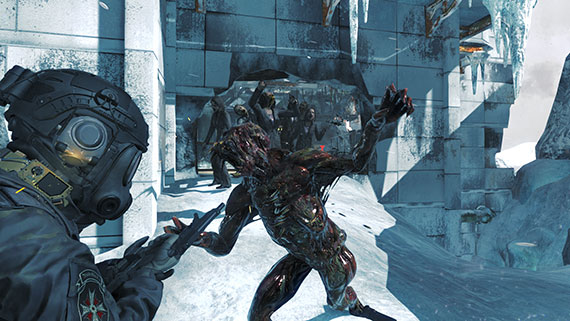
The newly unveiled Antarctic Base map offers players three levels of the fractured facility to explore and gain tactical advantage over the competition. Iconic locations from Resident Evil Code: Veronica can be spotted in the most recent screenshot gallery . Mercenaries can clash their Brainer melee weapons on the heliport where Claire battled the monstrous Alexander Ashford. The derelict factory floor presents ample cover for players to engage in firefights.

Take a closer look at the Antarctic Base map from Umbrella Corps in the new trailer below. This video sets the stage for the map’s place in RE history with an intro using Resident Evil Code: Veronica storyline footage (as seen in Resident Evil: Darkside Chronicles). Keep an eye out for brutal Brainer battles and locations you remember from RE Code: Veronica.

In addition to environments from Resident Evil Code: Veronica, a powerful threat is featured in the new screens. Special “Mutated Zombies” appear in the Multi-Mission Mode’s SP DNA Hunter rule set, where players can only win by defeating these powerful enemy variants. Mutated Zombies can deal heavy damage, take a beating, and are resistant to the normally pacifying effects of your Zombie Jammer pack. Even worse, enemies nearby Mutated Zombies are also immune to the Zombie Jammer, so stay frosty.

A handful of new weapons have also been revealed with new screens. The new batch of artillery includes a Brainer variant called the Talonhawk, and the Wolfsbane pistol. The robust gear customization options  of Umbrella Corps even allows players to paint their Wolfsbane gold to match the handgun type wielded by the late Steve Burnside in Code: Veronica.

These memorable locales and more are ready for your return when Umbrella Corps releases on PC and PS4 June 21 for $29.99. Visit our Facebook page to check out the full gallery of screenshots.

EN

Guile Joins Street Fighter V and April Update News

Apr 18, 2016 // Harrison Young

What’s up World Warriors!

We have a ton of new details to share with you today surrounding the next update for Street Fighter V, including the return of Guile along with his classic stage and some additional improvements to the online experience. Hit the jump for more details!


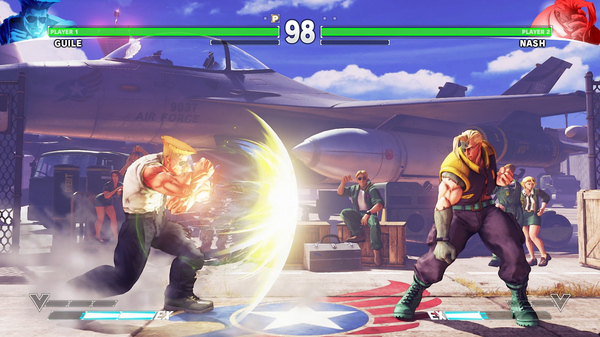
Check out more Guile screenshots at our Facebook page!


Guile is certainly one of the most iconic Street Fighter characters as he was one of the original eight World Warriors in Street Fighter II. His connection to Charlie Nash was revealed in his Street Fighter II ending as he prepares to finish off M. Bison once and for all for killing his friend and mentor but is stopped at the last moment by his wife Jane.


It wasn’t until Street Fighter Alpha 3 however where we learn more details about Guile’s search for Nash who had gone missing during a secret mission.  While Guile eventually found Nash at the Shadaloo base, their reunion was short lived as Nash held off M. Bison to allow Guile to escape and was the last time he saw the man who taught him how to throw Sonic Booms.


In Street Fighter IV, Guile’s search for Nash continues as his body was never recovered, and while unsuccessful in finding him, he does run into French MMA fighter Abel who is familiar with Guile’s fighting style. Guile knowing that Nash is the only other fighter that uses Sonic Booms presses Abel for more answers but is unable to get any new information.


While Guile has had a major role in most of the mainline Street Fighter games, he has also appeared in countless crossover titles such as Street Fighter x Tekken, Marvel vs Capcom series and Capcom vs SNK 2 .


Guile will be available for free later this month to all players until the Zenny shop launches and will receive his own set of Trials and Character Story. His Battle Costume will be available for free to all Season Pass holders as well.


CHARACTER OVERVIEW


In Street Fighter V , Guile retains his ability to dominate both the ground and air with his solid normal attacks and special moves, such as Sonic Boom and Somersault Kick. He also now has the ability to enter a crouch walk state called Faultless Move which allows him to keep his charge while moving forward, giving him even more options in his kit to keep his opponents in line. Guile is a great choice for those of you who are looking for a charge character who can easily control the pace of the match.


V-Skill: Sonic Blade


Guile spins up sonic energy to create a Sonic Blade which acts as a stationary projectile that can also juice up his Sonic Booms. Sonic Blade can really help Guile pressure opponents on their wake-up or help him win projectile battles as it increases Sonic Boom durability!


V-Trigger: Solid Puncher


Guile powers up and tosses out continuous Sonic Booms! Each button throws a Sonic Boom at a different speed, so mixing up between buttons can create interesting Sonic Boom sequences. Depending on the sequence used, this can act as a great combo extender, be used to overwhelm opponents or easily push his opponents to the corner.


Critical Art: Sonic Hurricane


Guile’s most devastating attack, the Sonic Hurricane! Guile powers up and hits his opponent with a massive, multi-hit Sonic Boom. This Critical Art receives a damage and range boost while his V-Trigger is active.


AIR FORCE BASE STAGE


We’re also excited to announce our first DLC stage, which is a classic that you all know and love: Guile’s Air Force Base! The jet receives a new coat of paint and you’ll probably recognize some familiar faces cheering you on in the background. This stage will be available in the Shop for 70,000FM. Season Pass holders will receive this stage for free as a thank you for supporting Street Fighter V .


RAGE QUIT SYSTEM


We’re also happy to announce that we will be implementing a system to punish players who frequently disconnect during matches (aka rage quitters).

The way this will work is the system will identify players who have high disconnect rates during matches and will lock them out of matchmaking for a period of time. Players who have been identified as abusing the system will receive an in-game message notifying them they have been locked out of matchmaking. More additions and enhancements to this system will be implemented in the future.


MATCHMAKING IMPROVEMENTS


We will also be making a number of improvements to Street Fighter V’s matchmaking. Many users should have an easier time creating and connecting to Battle Lounges and we are also loosening the restrictions on finding an opponent. We know users in Europe and other parts of the world have experienced some issues finding opponents and this should help increase the amount of battles coming their way.


That’s it for today! We’ll have details on the release date of the April update very soon so follow @StreetFighter for the latest news!

EN

Monster Hunter Generations introduces 4 Hunting Styles

Apr 14, 2016 // Yuri Araujo

Master 4 distinct Hunting Styles and customize your arsenal like no one else!

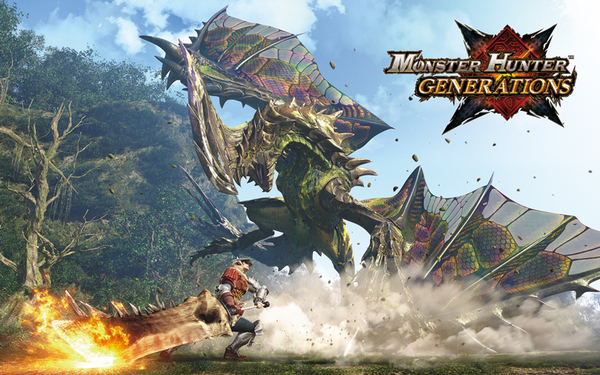
As briefly mentioned on our announcement trailer and blog Monster Hunter Generations introduces new ways to hunt, by letting you equip 4 distinct Hunting Styles, in addition to your weapon choice.

Catch our fresh new trailer highlighting this new feature, and a quick breakdown right below:

Aerial Style : “Death from Above” – This style gives every weapon class a short jump, called Aerial Dodge . By connecting this jump with a monster, another player or even a Barrel Bomb L, the player vaults him/herself into the air and can follow that up with devastating Jumping Attacks .

While aerial hit can lead to mounting a monster, also keep in mind this third movement dimension can be used to evade certain grounded attacks and avoid disrupting nearby teammates.

Can equip 1 Hunter Art.

Adept Style : “Deft Punisher” – With this style equipped, hunters gain  Insta-Moves that require precise timing. If your weapon has a heavy shield (Lance, Gunlance, Charge Blade in Sword Mode) your Insta-Move is an  Insta-Block : a quick swing of the shield that, if connects with an incoming attack, gives an opportunity for an immediate follow-up attack. Those sporting any of the other weapon types (or Charge Blade in Axe Mode) gain an Insta-Evade , which features a good number of i-frames and can either set up a powerful follow-up attack or be used to be out of harm’s way.

Can equip 1 Hunter Art.

Guild Style : “Well-honed Tradition” – This style will feel most familiar to those that played  Monster Hunter 4 Ultimate , so if you’re looking to test your skills with your favorite weapon, or just and all-around solid set up, Guild Style is for you.

Can equip 2 Hunter Arts.

Striker Style : “Versatile Powerhouse” – In order to truly understand this Hunting Style, one must also understand the all-new Hunter Arts. These special moves build up as you hit monsters and can be unleashed with a single tap on the touch screen panel.

The nature of Hunter Arts can vary drastically from handy tools, like the  Hunters’ Oasis , which sets up a small fountain that heals those neaby; to more powerful weapon-specific abilities, like the Gunlance’s  Blast Dash , which does exactly what it sounds like: uses a blast from the Gunlance to push you forward. It goes really far, fast and can be followed up with an overhead slam – counts a Jumping Attack too!

These were just 2 examples. In the full game, you’ll be able to unlock 10 Hunter Arts that work with every weapon type and 3 weapon-specific Hunter Arts.

Now that we’ve covered Hunter Arts, imagine what kinds of setups you can build if you could equip 3 Hunter Arts… that’s where Striker Style comes in. =)

Monster Hunter Generations will be availabe on the Nintendo 3DS this summer, which is rapidly approaching, so start thinking: which style will you focus on? Or will you attempt to master all 4?

EN

Tito Ortiz streaming SFV live on Twitch tomorrow

Apr 13, 2016 // Kellen Haney

Even if you’re not familiar with Tito Ortiz, you’ve undoubtedly heard his name in passing – an unstoppable force of MMA, Ortiz will be trying out a different kind of fighting tomorrow night with none other than Street Fighter V! Featuring special guests from the LA Kiss Dance team, Ortiz will be streaming LIVE for the first time on Twitch, inviting viewers and fans to fight against him outside of the octagon and on the stream, as well as giving out some incredible prizes!

Wanna get ahead of everyone else? Make sure your PS4 or PC and SFV is ready at 6:30pm PST, and follow Ortiz at twitch.tv/titoortiz !

EN

14 Questions about working in the games industry

Apr 12, 2016 // Jeffery Simspon

At Capcom Vancouver we get a lot of people asking how to break into the video game industry. From the outside it may seem an insurmountable task at times and yet clearly it happens. Someone has to be making all of these video games. Zombie AI doesn’t write itself.  

Unless it does, and that’s a frightening thought.  

Recently we received an email from Lukas, a grade 10 student at Abby Secondary in Abbotsford British Columbia, asking us 14 questions for a career planning course. We passed the questions to a few different people in the studio and decided to share their answers here.

Jason Buchwitz, Art Director 


How did you get started in this occupation?

I’ve been an artist for as long as I can remember. My career in CG/gaming started 18 years ago by knowing someone in the online casino industry. They were impressed with my traditional art skills with drawing and painting and I was able to basically learn 3D modeling on the job. 


What did you do to prepare for this occupation?

A life time of drawing and painting almost every single day and a passion for gaming ever since early childhood  


What can I do to prepare for this occupation?

Try things. Don’t be afraid to fail. Find out what you’re REALLY good at which will line up with where your passion is. Practice, practice, practice and refine your skills. Learn how to present yourself and your work well. Never spread yourself thin by trying to be good at too many things.  


What is the most important thing you learned during your formal training related to this occupation?

That I will never stop learning.  


Knowing what you know now, would you choose the same job again?

Absolutely. I love what I do. I love being able to express my creativity on a daily basis and work with other amazing creative people.  


What skills are necessary for this occupation?

It all depends on what discipline you want to go for. A passion for games and collaborating with creative people is a good place to start. 


Describe what you do in a typical day.

As an Art Director, much of my time is spent with the art team on the floor and in formal art reviews providing feedback and direction. Managing the art teams and collaborating with the design and technology groups make up a typical day. When I’m not on the floor, I can be found at my desk establishing the art vision for the game so that any feedback and direction I provide comes from a solid foundation.  


What do you like the most about your occupation? The least?

I like working with incredibly creative people the most. The least would be anything that takes me away from this.  


What type of people do you work with?

Highly creative and passionate people!  


What is your company trying to accomplish?

We want to continue to establish ourselves as an industry leading AAA game development studio.  


What advice would you give to a young person entering this occupation?

Don’t be silent. Take advantage of the experienced people surrounding you to learn and grow in your career.  


Can you tell me what the job outlook is for this occupation?

Game development is here to stay. Rapid innovation in our industry combined with highly creative people pushing the envelope all point to a very exciting future.  


What changes have occurred in this occupation?

As mentioned above, so much innovation has occurred in the last 30+ years. Tools for building games are becoming more and more accessible. Take advantage of this. 


Can you recommend any other information about this occupation?

Because of the accessibility of game development tools and online tutorials, take the time to learn them. The only limiting factor here is yourself:)


Steve Pearce, Software Engineer


How did you get started in this occupation?

I think I got really lucky. I was finishing up a Master’s degree in computer science focusing on document recognition type stuff. I sent resumes out all over Ontario but the job market was a bit dry.  

I had only sent one resume out to a game company, and that was EA in Burnaby. It was a bit of a pipe dream, I grew up in a small community with the thought that the tech industry was mostly for banks and Universities, and my resume reflected that, it was pretty standard, and very dry. I had no idea what the video game industry was like. I started to get really excited about the idea of making games, and after not hearing back from EA for a week, I followed up to show my enthusiasm. I happened to catch the recruiter at just the right time, he replied back within an hour, and I replied right back. After an initial phone screen on a Friday afternoon, I got feedback that I seemed like a good candidate, but that I just didn’t seem interested enough in games.  

I spent that night re-doing my resume ( while my roommate was throwing a party ), and sent the recruiter a new one that was basically a character profile from a game I made up. Education became intellectual guilds, experience became quests completed, and goals became quests. He called back Monday and asked when I wanted to fly out for a real interview.  


What did you do to prepare for this occupation?

Nothing specific in the years leading up to it. I tried hard in school and got good grades. When the time came for my first interview, I played all the games that had been mentioned to me. Coming in prepared is so important, and shows you’re willing to spend the extra time just in case it’s important.  


What can I do to prepare for this occupation?

These days there are a lot more options at school. Learning something about all aspects in that setting can be a huge advantage, AI, rendering, and systems are particularly important. If you want to work on consoles or mobile, you should also learn a bit about hardware because it actually makes a difference. Efficient code can look different on different hardware architecture.  


What is the most important thing you learned during your formal training related to this occupation?

The most important thing you can ever learn is how to learn. There is no way you can anticipate the challenges you’ll be faced with, so being able to find your own answers is the key to success.  


Knowing what you know now, would you choose the same job again?

Yes. There are always days when the challenges seem like they can crush you, but the first time your friends play your game and think it’s awesome, it’s all worth it. 


What skills are necessary for this occupation?

There are so many different roles on a video game team, that any and all skills are valuable. In general, you need to be smart enough to solve challenging problems, and patient enough not to get overly frustrated when plans change. You have to be able to communicate ideas with people of all different backgrounds. On any given day you may be talking AI with a designer that has never built a state machine, acting out animation sequences with an animator, and talking low level cpu performance with other engineers.  


Describe what you do in a typical day.

My current role is a game play lead, so I currently oversee about 10 game play engineers. So I spend my day doing all sorts of different tasks. I may attend feature meetings, where I work with designers to figure out what our game is, what our engine can do, and how we can take advantage of that. I’ll do the same with engineers, but it’s more technical and we talk about coding patterns, and bugs to look out for. The other aspect of my job is to help with planning and scheduling, and trying to make sure we can achieve what we set out to do.  

My previous role, was as an AI engineer. I would spend my entire day thinking like a zombie. I worked on pretty much every aspect of the AI and game play. Some days I’d work on perception, so that zombies could detect the NPCs and lures, and other days I’d work on individual behaviours, and what animations they would play. Near the end of a project, there is always a period of optimization and bug fixing, where things became a lot more technical, and I would be worrying about cache misses, and efficient algorithms.  


What do you like the most about your occupation? The least?

What I like most is that I get to be creative. I spend just as much time talking about what a zombie or NPC would do, as I do making it happen. We are successful if things are fun. What I like least are the crunch times. In any industry there are deadlines you have to hit, but with games, we all want to do the best job possible, and sometimes that can mean putting in some extra time to make adjustments that weren’t planned for. I think those times are a lot like studying for finals, where it doesn’t matter how much you know, you always want to know more to get a better grade.  


What type of people do you work with?

All types of people. There are visual artists, animators, audio artists, designers, engineers, and managers. Each discipline draws a different kind of person, with different skill sets and backgrounds. Engineers tend to be more technical, and like math. An animator has likely never heard of a quadratic equation. But, despite all the differences, we are all working towards a common goal, and we all get along.  


What is your company trying to accomplish?

As a company we want to make great games that people want to play.  


What advice would you give to a young person entering this occupation?

  Study hard, but don’t be just a student. In the entertainment industry you have to keep up to date on what the trends are. I like to play other games and think about how they’ve solved, or avoided some problems. For engineering you have to be well rounded, and know about hardware and algorithms. Taking some art or rendering courses never hurts either, because it’s all things you’ll hear about at work and you will understand more what people are trying to say. Being passionate about something you want to accomplish is always a bonus too, if you want to do AI, come with a plan of how you would make the best ever partner AI.  


Can you tell me what the job outlook is for this occupation?

I think the outlook is really good. There are always jobs open with the bigger companies, and smaller studios start up all the time. It’s even possible to make a good living totally independently.  


What changes have occurred in this occupation?

 The technology has changed quite a bit in the last 10 years. There are always new generations of consoles coming out, and online games have become a really big deal. Smaller mobile studios are also a relatively new thing.  


Can you recommend any other information about this occupation?

Not really, it’s very diverse. If you want to be an engineer, it’s all about problem solving, math, and skill at programming. Make sure you research the studios and technology you’re targeting, and brush up on anything you think might be helpful. When I interview candidates, it shows a lot if they’ve played or at least watched videos of the games we make. Coming to Capcom, and talking about Halo won’t get you as far as talking about Dead Rising .

Jeffery Simpson, Community Manager


How did you get started in this occupation?

My background in writing helped and I had also been working in customer service for a cellular carrier and so those skills directly translated over to dealing with fans online. I also was a fan of the studio’s first game and had been immersed in fan culture myself so I knew how to talk to fans.  


What did you do to prepare for this occupation?

I went to the University of British Columbia with and came out of it with a degree in History and a minor in English. While that doesn’t seem directly applicable it taught me critical thinking and how to write well. I then spent over a decade in various jobs dealing with the public and doing customer service, from working at McDonald’s in high school to a movie theatre and on. Each job taught me how to talk with customers, how to respond to complaints and how to make people happy when something goes wrong.  


What can I do to prepare for this occupation?

Learn to write clearly and in an entertaining fashion. Learn about and use social media. Be a fan of things and let that passion show. Studios want to hire people who love games as Community Managers because they’re the people who get the fans exciting about what’s next.  


What is the most important thing you learned during your formal training related to this occupation?

There was never much formal training for the role and every studio or publisher in the industry sees a Community Manager as a different thing. Probably the best thing I learned was back in my old cellular customer service job and that’s the importance to people of being heard and having their feelings acknowledged. I’m not always going to be able to do everything people want, but it’s powerful to be able to say, “I understand why you’re upset and let’s see how we can make it right.”  


Knowing what you know now, would you choose the same job again?

I think I’d like to have studied computer science. The people on the technical side of the industry seem to have the best job security and getting to be so key to the creation of games would be exciting. But that doesn’t mean I’ve got any regrets, this is pretty much the best job a History Major could ask for in the industry.  


What skills are necessary for this occupation?

Writing. Reading. Listening. Also a thick skin, people on the Internet can say some pretty strong things and sometimes I get to be the target of misplaced anger.  


Describe what you do in a typical day.

I typically post something on our social media channels in the morning, and monitor how that performs through the day. For each post I study what worked and what didn’t so that the next day’s post will be even better. I do a lot of writing, check our studio’s incoming email and read what people are saying about us and our games online.   There’s a lot of variety, some days it’s all blog writing and other days I’m walking around interviewing people in the studio for a video we’re making.  

Then there’s the times I get to go to exciting events like E3 in LA or Gamescom in Cologne Germany. While those are a lot of work, it’s an incredible time and maybe my favourite thing about the job.  


What do you like the most about your occupation? The least?

Apart from getting to go to events like E3 I love being able to talk with fans who are passionate about games. And while I don’t make the games myself, being a part of the teams that do is really exciting.   The worst part is probably when I know some exciting news but I have to keep it to myself.  


What type of people do you work with?

Smart people. My first job in the industry was one of the first times that I felt like I was clearly the dumbest person in the room. And while I’m more confident of myself today than I was back then, it still shocks me how smart the people who make games are.  


What is your company trying to accomplish?

To make great games. Games people love.  


What advice would you give to a young person entering this occupation?

Always be honest. There’s going to be times when it might seem easier to say what people want to hear, and that will make them happy for awhile, but be honest and upfront with everyone. Sure you won’t be able to tell everyone everything, things have to stay secret in the industry at least until they’re announced, but be as honest as possible.  


Can you tell me what the job outlook is for this occupation?

It’s limited. Every studio should have a Community Manager, or a few of them, but unlike a lot of other jobs there’s not a lot of open positions. At Capcom Vancouver I’m the first one they’ve had for a while now and that’s one job out of over 200 staff we have here. But if you’re good at what you do, opportunities will open up.  


What changes have occurred in this occupation?

Live streaming video is much bigger than 6 years ago when I started. Twitch is a big deal now and being able to leverage that is important. There’s also a far greater focus on “influencers” which are people with large audiences on Twitter or Snapchat or another network who you want to say good things about your game. In a way that’s made a Community Manager much more a marketing type job than it used to be.  


Can you recommend any other information about this occupation?

There’s a few books on it, but none that I’ve found that useful. A book about the power of crowds that I’d recommend is Clay Shirky’s Here Comes Everybody: The Power of Organizing Without Organizations that talks a lot about how information spreads on the internet and how things go viral. The Game evelopers Conference (GDC) has a website with videos of their past events and they have a lot of panels on Community topics, it’s worth taking a look there.  


Dylan Hunter, Technical Artist


How did you get started in this occupation?

I always drew flipbooks in school, then in college, when I was becoming an engineer, I discovered 3D software and fell in love with it. Toy Story came out and showed me that it’s possible to get paid to do this, so I went to animation school in Vancouver and slowly worked my way into the industry, starting with TV cartoons.    


What did you do to prepare for this occupation?

  More than anything, I tried to maintain a good work ethic and maintain a passion for what I do, it is a labour of love and so so rewarding.    


What can I do to prepare for this occupation?

Much like above, the most important thing is to constantly practice your art, working on your own stuff, and keep your passion full by staying up to date, and staying inspired by looking at what other people are doing. It’s important to keep our motivation in check.    


What is the most important thing you learned during your formal training related to this occupation?

I would say it’s the need to leave my ego at the door and that it’s ok to make mistakes. Ultimately it’s all a group project to make the best possible game for our gamers through a combined effort, not my effort. Especially more artistic work, sometimes we wear our heart on our shoulders so to speak, but it’s never ever personal.   


Knowing what you know now, would you choose the same job again?

Absolutely, in a heartbeat. I love waking up in the morning, getting to work early and I genuinely look forward to going to work. I feel blessed and fortunate to have a job I love to do; it can be tough at times and demanding, but I wouldn’t change it for anything.  


What skills are necessary for this occupation?

So I started out as an animator, but I am now a technical artist. For myself, the ability to study weight and motion was hugely important, believe it or not, drawing is not a huge prerequisite. For the more technical stuff, those are skills I have built slowly over time through extracurricular courses and such; such as coding/scripting, and deeper use of 3D software like modelling, rigging, texturing, etc. Many of these you can learn at specialized schools. More than anything, it’s important to be able to built a network and be able to communicate, as well as just show a genuine passion.  


Describe what you do in a typical day.

My days are pretty erratic, but will often involve taking models the artists have made, putting a skeleton in them to create a rig that is animatable and then weight the skin onto the bones. Then bring that into game and set up logic and state machines for the different animations to go through based on player choice. I’m kind of a jack of all trades right now though, so my daily tasks are really all over the place.  


What do you like the most about your occupation? The least?

I love the people I work with and the fact that the work itself is genuinely gratifying. I least like the corporate humdrum tasks that have to be done as part of it though (eg. emails, logging work and tasks, etc)    


What type of people do you work with?

I work with people of all walks of life and ages, which is great, but everyone I work with loves games and seem to embrace their inner nerds.    


What is your company trying to accomplish?

Capcom (Vancouver) in particular is a studio that is really trying to embrace a healthy work culture and environment; they really seem bent on making people happy and want to stay, which is refreshing in this industry at times. They want to make the best quality games we can, but make them efficiently and take in creative ideas and initiative from all the employees, I think that is really cool. Myself, as an example, I did a sideways transition from animator to Tech Artist and Capcom fully supported that move.    


What advice would you give to a young person entering this occupation?

All it takes is tenacity; landing your first job is going to be the hardest, but don’t ever give up. Networking is important, but showing that you are constantly improving is even moreso. It only takes one yes out of a hundred nos.    


Can you tell me what the job outlook is for this occupation?

Good, very good. There is a lack of sound Technical Artists out there. Partly because it is left and right brained work, but they will always be useful, as it’s not really a job that is outsourceable. There will always be jobs for animators as well.    


What changes have occurred in this occupation?

Mostly it’s just keeping up with technology. I’ve noticed as a TA, I have to ramp up on new tech and ideas faster than others, because artists come to me for answers so I better have them. Tech can change so fast, it’s actually pretty exciting at the same time.    


Can you recommend any other information about this occupation?

If you go the route of animation, I highly recommend animationmentor.com, not only do you get taught by seasoned professionals, but they also instill and build a great sense of community, which is super helpful for keeping that passion strong and building that community and network. Becoming a tech artist isn’t something that happens straight out of school, but consider taking additional courses in programming, life drawing, etc, what ever you find interesting.   Never give up on your dreams and they won’t give up on you.  

EN

New Details on Player Customization Options in Umbrella Corps

Apr 07, 2016 // Tim

Umbrella Corps pits players against one another in dangerous battlefields brimming with bio-organic threats likes zombies and Ganados. Outfitting your mercenary with powerful gear is critical for dominating in battle against both human and inhuman enemies. Today we’ve got new details on how players will be able to customize their own weapons, armor, and character emotes.

For the uninitiated, Umbrella Corps is a competitive, online third-person shooter set in the Resident Evil universe. Match types like One-Life Match and Multi-Mission Mode generally involve up to three-on-three shootouts that reward quick reflexes and steady aim. Zombies, infected canines, and other B.O.W.s will also swarm players if their Zombie Jammers take damage during a shootout, adding the tension of a looming threat to every battle.

Defeating rival teams of mercenaries and eliminating zombified threats on the battlefield are examples of ways players earn points that can be used to unlock parts to customize your mask, helmet, shoulder armor, body armor, and Zombie Jammer parts. Players can swap out different designs of their zombie-nullifying backpack. You can also express your inner merc by plastering your body armor with awesome decals like B.S.A.A. patches, Umbrella logos, and deep cuts like the Spencer Family crest.

Powerful new weapons can also be unlocked and customized. For example, the Doberman Pincer is a lethal shotgun that devastates enemy players and creatures alike, and is perfect for shutting down attempted Brainer melee assassinations. The K-12 AX is a well-rounded SMG, delivering a balance of range and fire rate. The Samurai Edge is a legendary firearm from the Resident Evil series – a modified, enhanced S.T.A.R.S. handgun designed by the Kendo’s Gun Shop of RE 2 fame. Each weapon can be decked out with a range of helpful scopes to boost accuracy or suppressors to keep your location concealed during matches.

Players can also customize their emotes using a system called I.C.O.N. (Interconnected Communications Operations Network). These interchangeable I.C.O.N. emotes let players use sounds and gestures to nonverbally communicate with other players quickly, whether that means leaping into the air with the celebrator “Woo-hoo” emote or even utilizing animal noises. Whatever gets the job done.

Umbrella Corps is coming to both PC and PlayStation 4 as a digital download for $29.99. Originally scheduled for release in May, Umbrella Corps is now launching just a little later on June 21 so the development team can spend some extra time optimizing the game to bring you the best experience possible.

For more on the customization options of Umbrella Corps, watch the video below.

Check out the new screens, too!

The “Woo-hoo” gesture demonstrated in full force

Check out more screenshots of mercenary customization in Umbrella Corps at our Facebook Page .

EN

Mega Man Legends 2 available now in North America [UPDATED]

Apr 05, 2016 // Kellen Haney

UPDATE: The game is now available on PS Vita!

Boy, do we have a treat for you today. Much like a fine wine, some game releases just can’t be spoiled – they simply improve with age. It’s my distinct privilege to announce that the beloved action adventure game Mega Man Legends 2 is available now for download on PSN for $9.99, and playable on PS3! Joining the original Mega Man Legends and The Misadventures of Tron Bonne, all three games are available for purchase on PSN in North America! 

Highly regarded by fans and critics alike as one of the best games on the original PlayStation, Legends 2 polishes the gameplay of the first to a mirror shine, shines it up just a little bit more, then removes that finger print it left, then sends you on your way to earn your first Digger license and get to exploring in search of legendary treasure! Much like the first game, you’ll explore various dungeons, equip a variety of weapons and parts to progress, and meet a vibrant and colorful cast of characters – including Tron Bonne and her Servbots – as you uncover a plot that digs a lot deeper than what the opening might suggest.

Of course, if you’re already familiar with all that, you’ve DASH ed off to PSN to grab the game already! But if you haven’t… there’s a monkey. A monkey! A robot monkey. It’s wearing a diaper and everything!

EN

Capcom Japan show off their real-time sound design skills with 360-degree video

Apr 04, 2016 // Kellen Haney

There are a lot of unsung heroes in the video game industry, and today we’re happy to bring you a very special look inside the Capcom Japan sound studio. The team has been experimenting with the latest in 360-degree camera and sound technology so take a peek at some examples of how they design the various sounds that bring Capcom games to life – in “real time!”

If you’re in a desktop browser, use your mouse to drag the view around, or if you’re on a newer mobile phone, just move your phone to change the view. Pretty incredible how they do it, huh? What? Don’t give me that look.

Okay, okay, confession time – you might have noticed that maybe this isn’t exactly how they design the sound for games, but that is really one of Capcom Japan’s sound designers “making” the sounds on Foley Stage, a stage built last year for future projects. The team wanted to have some fun with the latest tech, and we thought it’d be great to share it with all of you. Hope you enjoyed the video!

EN

RE 20th Anniversary Video – Koji Oda Talks Resident Evil 0

Apr 04, 2016 // Tim

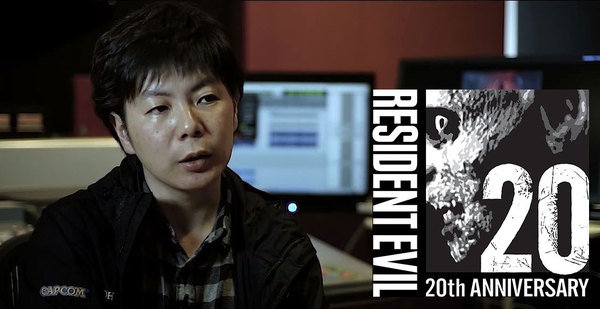
Our yearlong celebration of the Resident Evil series 20 th anniversary continues with a video featuring Resident Evil 0 mastermind, Koji Oda. Although his work on the series began with the 1996 original, Oda-san is most known as director of the 2002 GameCube prequel, Resident Evil 0. In this anniversary video, Oda-san remembers his time developing the last entry to follow RE’s classic formula, comparing the foreboding fixed-camera angles to film. Oda-san also discusses the philosophy behind writing Rebecca and Billy’s prequel story into the existing storyline and the teams original plans for adding Wesker Mode into the recently released Resident Evil 0.

As the director of Resident Evil 0, Oda-san offers interesting insight into how Capcom’s Japan-only NES horror game, Sweet Home, influenced t his title and the rest of the series. Oda-san also dives into Capcom’s goal to make fugitive Billy Coen a dark, mysterious character that didn’t have previous connections to the series storyline.

For more videos featuring Oda-san discussing his time working on Resident Evil 0, including the original prototype build, watch our Developer video series. To watch the first RE 20 th anniversary video from producer Hiroyuki Kobayashi, click here . Stay tuned for more macabre mementos celebrating Resident Evil’s 20 th Anniversary.

EN

Capcom Vancouver Goes Social

Apr 04, 2016 // Jeffery Simspon

We see you, glancing at us wondering why in 2016 we decided it was finally time to tell you that we have a Twitter account. There’s cats that have Twitter accounts these days, so why are we so proud of having one?  

We’ve actually being sharing what’s been going on inside the studio for years now, we just wanted to make sure everyone knew all the options in the “Follow Capcom Vancouver” free buffet that is the internet.  

  You can connect with us on:  

  • Facebook : for regular updates on jobs, studio life and Capcom projects
  • LinkedIn : for details about our open jobs and how you can become part of the team
  • Twitter : where we talk to fans of our games and provide a look behind the curtain here at one of Vancouver’s biggest game studios
  • Instagram : our newest social network will offer a behind the scenes visual look at what we’re doing both in Vancouver and around the globe
  • YouTube : for our game trailers and other longer form videos

 We really believe that our fans are a big part of what makes our games special and we’re excited to have so many venues to connect with you. There are cool things happening inside the studio and we’re growing to work on some great projects.    

We’re glad to have you with us on this ride.¹      


  ¹ Your cat can come too, as long as it follows us on Twitter.

EN

Hold It! The Ace Attorney anime debuts on Crunchyroll this weekend

Apr 01, 2016 // Kellen Haney

If you’re anything like me when it comes to Ace Attorney, you probably read that headline and are desperately looking for a link. So here it is ! Need more details? We’re very happy to present to the court that our partners at Crunchyroll will be bringing Gyakuten Saiban (literally “Turnabout Trial,” the name of the series in Japan) direct to your faces, with the first subtitled episode debuting this Saturday, April 2 at 4:00AM PST, just a short time after it airs in Japan, with new episodes each Saturday after! Surely you can’t object to that, Wright?

Touching on the beginning and early stories of the series, the anime will reintroduce fan-favorite characters, including the ace attorney who always turns things around, Phoenix Wright (Naruhodo Ryuichi), the cool and pragmatic prosecutor, Miles Edgeworth (Mitsurugi Reiji), the spunky spirit medium in training, Maya Fey (Ayasato Mayoi), and a whole cast of the colorful characters that make up the world of Gyakuten Saiban. I mean, who doesn’t want to see Winston Payne (Auchi Takefumi), the Rookie Killer himself, in action?

On second thought… don’t answer that. Since the episodes will be subtitled, each character’s Japanese names will be used. It might take a bit of getting used to, so we’ve compiled a quick list for you all of some of the characters’ names that you just might see and hear (don’t forget, surnames are first in Japanese):

Naruhodo Ryuichi (Phoenix Wright)

Mitsurugi Reiji (Miles Edgeworth)

Ayasato Mayoi (Maya Fey)

Ayasato Chihiro (Mia Fey)

Yahari Masashi (Larry Butz)

Itonokogiri Keisuke (Detective Gumshoe)

Auchi Takefumi (Winston Payne)

Oh, and don’t forget to water Charlie!

UPDATE: Not quite the same with Japanese names? We have evidence that shows if you right click on the Crunchyroll web player, you can find an alternate subtitle track that includes each character’s English names. Isn’t that right, Wright?

EN

Makers & Gamers brings a legendary player and a legendary franchise together

Mar 31, 2016 // Kellen Haney

What happens when two legends of Street Fighter meet? Working with PlayStation, Lucy Walker brings us a documentary on two major figures of the storied franchise – Darryl “Snake Eyez” Lewis, regarded as one of the best Zangief players in the world, and Yoshinori Ono, Executive Producer of Ultra Street Fighter IV and Street Fighter V. The documentary explores both what it takes to play a game and what it takes to make a game, and the ever-changing relationship between the two. It’s well worth your time, so if you’ve got a few minutes, check it out!